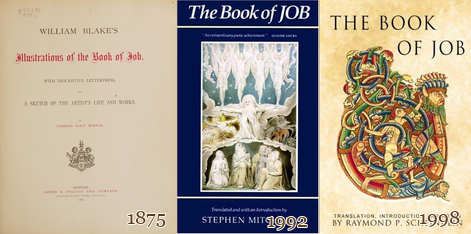
- 1875: William Blake's Illustrations of the Book of Job
- 1992: Stephen Mitchell translation
- 1998: Raymond P. Scheindlin translation
Book of Job
A fierce argument with easy answers.
Overview
The Book of Job is a Hebrew poem framed by a hard story: a good man loses the life he knew, then refuses the easy claim that pain must prove guilt. Most of the book is not action. It is a contest of speeches, with Job and his friends arguing over justice, knowledge, and what a person can ask of God.
Its real force lies in the argument. The friends keep turning suffering into a moral lesson. Job will not let them. Then the book opens into a storm of questions about the world beyond human control. It is short, but its poetry is dense and its questions don’t loosen their grip quickly.
The King James Version gives the book some of its most remembered English lines, though its language can slow a first reader. Try a modern translation beside it if the older phrasing feels closed. Read in small stretches, and let the speeches disagree.
Is This Book for You?
Yes, if...
- You want a short, intense book that refuses easy answers about pain and justice.
- You like arguments, strange images of the natural world, and language that presses hard.
- You are willing to read an old translation slowly, with notes close by.
No, if...
- You want a calm devotional read with simple lessons and quick comfort.
- You dislike long speeches in which people argue past one another.
- You need a story that explains every question it raises.
Summary
Notable Quotables
“Where wast thou when I laid the foundations of the earth? declare, if thou hast understanding.” — translation: King James Version translators
“But he knoweth the way that I take: when he hath tried me, I shall come forth as gold.” — translation: King James Version translators
“I know that thou canst do every thing, and that no thought can be withholden from thee.” — translation: King James Version translators