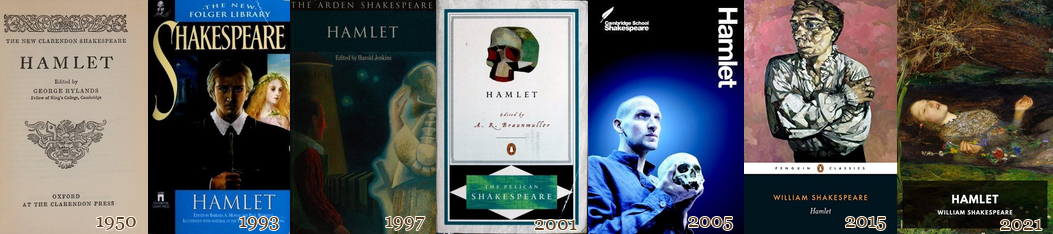
- 1950: Oxford, New Clarendon Shakespeare (ed. George Rylands)
- 1993: Folger Shakespeare Library, Washington Square Press
- 1997: Arden Shakespeare
- 2001: Pelican Shakespeare, Penguin Books
- 2005: New Cambridge Shakespeare, Cambridge University Press
- 2015: Penguin Classics
- 2021: Standard Ebooks edition
Hamlet
A ghost, a throne, and a prince who cannot make himself act.
Overview
Hamlet is Shakespeare’s tragedy of a Danish prince who comes home from study to find his father dead, his mother already married to his uncle, and a ghost on the castle walls claiming that the uncle murdered the king. The play is about what Hamlet does next, and keeps not doing, with that order.
It holds the most famous speech in English, but reading it is less about that one soliloquy than the pressure tightening around it. The court at Elsinore is watched, lied to, and turned into a stage. Hamlet pretends to be mad, or perhaps is, while spies report on everyone and the real danger stays out of sight.
The language is early modern English, quick and dense with wordplay, grief, and jokes that cut. An annotated edition makes a large difference. The story is widely known, yet the play keeps asking why Hamlet waits, and the answer shifts a little every time you read it.
Is This Book for You?
Yes, if...
- You want the most quoted play in English in its full, original form.
- You like drama built on inner pressure, doubt, and a hero who keeps arguing with himself.
- You're reading for school, for the stage, or for the lines everyone half-remembers.
No, if...
- You want a fast plot that drives straight from problem to solution.
- You find early modern English, verse, and wordplay hard going without notes.
- You want clean answers, because this play trades in uncertainty on purpose.
Summary
Notable Quotables
“To be, or not to be, that is the question:”
“There are more things in heaven and earth, Horatio, / Than are dreamt of in your philosophy.”
“Something is rotten in the state of Denmark.”