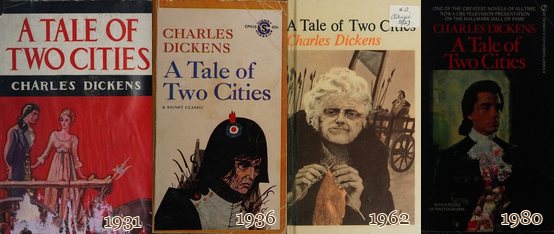
- 1931: Houghton Mifflin edition
- 1936: New American Library edition
- 1962: Washington Square Press edition
- 1980: New American Library edition
A Tale of Two Cities
Love, fear, and sacrifice at the edge of the French Revolution.
Overview
A Tale of Two Cities is a historical novel set in London and Paris before and during the French Revolution. A young family, a troubled lawyer, and a Frenchman with a dangerous name are pulled into a crisis that starts in old cruelty and ends in public terror.
This is one of Dickens’s tighter long books. It has secret letters, trials, prison rescues, a fierce wine-shop couple, and a plot that keeps narrowing around a few people. The early chapters take their time, but the pressure rises fast once the story moves to Paris.
Expect strong feelings, sharp contrasts, and some broad villains. The Revolution is not just a backdrop here. It changes what safety, loyalty, and even love can cost. A modern edition can make the humor and formal passages easier to hear.
Is This Book for You?
Yes, if...
- You want a tense historical novel with courtrooms, prison cells, and a love story under pressure.
- You like Dickens when his big cast serves one strong plot.
- You can enjoy a book that turns from London calm to Paris terror.
No, if...
- You want the French Revolution told with modern speed and plain language.
- You dislike coincidence, melodrama, and villains drawn in bold lines.
- You need every character to feel subtle before the plot can move you.
Summary
Notable Quotables
“It was the best of times, it was the worst of times, it was the age of wisdom, it was the age of foolishness, it was the epoch of belief, it was the epoch of incredulity, it was the season of Light, it was the season of Darkness, it was the spring of hope, it was the winter of despair, we had everything before us, we had nothing before us, we were all going direct to Heaven, we were all going direct the other way--in short, the period was so far like the present period, that some of its noisiest authorities insisted on its being received, for good or for evil, in the superlative degree of comparison only.”
“I see a beautiful city and a brilliant people rising from this abyss, and, in their struggles to be truly free, in their triumphs and defeats, through long years to come, I see the evil of this time and of the previous time of which this is the natural birth, gradually making expiation for itself and wearing out.”
“It is a far, far better thing that I do, than I have ever done; it is a far, far better rest that I go to than I have ever known.”