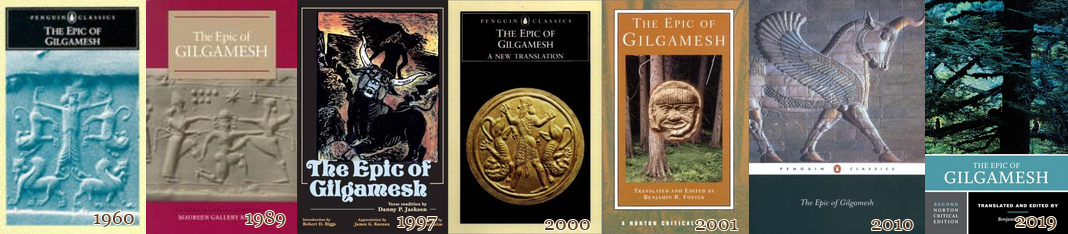
- 1960: Penguin Classics edition, translated by N. K. Sandars
- 1989: Stanford University Press edition, translated by Maureen Gallery Kovacs
- 1997: Bolchazy-Carducci edition
- 2000: Penguin Books edition, translated by Andrew George
- 2001: Norton Critical Edition, translated and edited by Benjamin R. Foster
- 2010: Penguin Classics edition, translated by Andrew George
- 2019: Norton Critical Edition, translated and edited by Benjamin R. Foster
Epic of Gilgamesh
A king learns what strength cannot keep.
Overview
Epic of Gilgamesh is an ancient Mesopotamian poem about a mighty king who meets the one person able to change him. Gilgamesh and Enkidu begin as rivals, then become friends and chase glory through a world of gods, monsters, and dangerous choices.
The action is quick, but the poem does not stay a simple monster story. When loss reaches Gilgamesh, his hunger for fame turns into a search for a way past death. That shift gives this short epic its force. It cares about what power can do, what friendship costs, and what remains when no one can live forever.
Read a good modern translation, and expect some rough edges. The tablets are damaged, versions differ, and names may be spelled in more than one way. Still, the main story comes through clearly. It is brief, strange, and much more human than its age might suggest.
Is This Book for You?
Yes, if...
- You want an ancient adventure with a proud king, a wild friend, gods, monsters, and a hard journey.
- You like short epics that ask big questions about friendship, grief, and what a life can leave behind.
- You are willing to read a translation with gaps, repeated lines, and names that may change by edition.
No, if...
- You want a smooth modern novel with one fixed text and a large cast you know well.
- You need a story with no religious world, ritual language, or strange turns from the gods.
- You want a light adventure that stays far from loss and the fear of death.
Summary
Notable Quotables
“He saw the secret and uncovered the hidden, he brought back a message from the antediluvian age.” — translation: Andrew R. George
“As for man, his days are numbered, whatever he may do, it is but wind.” — translation: Andrew R. George
“He built the wall of Uruk-the-Sheepfold, of holy Eanna, the pure storehouse.” — translation: Andrew R. George